March 13, 2013 COMMENTARY BY: Thérèse Postel TOPICS: Foreign Policy, Responding to Upheaval in the Arab World
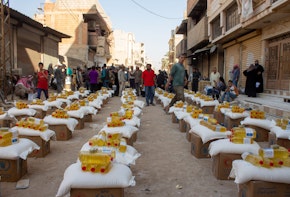
Since February of 2011, thousands of protestors have hit the streets of Bahrain, demanding democratic change and equality under the law. The Al-Khalifa regime has reponded with shocking force, often using Western weapons, and has shown little desire to engage in dialogue with the opposition or implement reforms.
READ MORE
March 11, 2013 COMMENTARY BY: Thanassis Cambanis TOPICS: Foreign Policy, Responding to Upheaval in the Arab World
For the first time, a couple in Lebanon has defied centuries of law and practice by getting married in their own country under civil law. Their wedding is more than a symbolic act of protest; it’s a carefully constructed legal challenge to the common practice across the Middle East of leaving marriage and all other personal affairs to clerics and their religious code.
If the couple succeeds at forcing the Lebanese government to officially recognize their marriage, the state will have to draft a whole raft of new laws to deal with everything from inheritance and custody to voting rights, since the couple has removed religious sect from their identity cards. It’s a long-overdue initiative from the embattled secularists of the Middle East. All over, clerics have had the momentum. In the Arab world, almost all states leave personal matters for the majority to Islamic law and for minorities to their own sectarian courts. Secular Jews in Israel have long bristled that marriage and conversion solely fall under the authority of the ultra-Orthodox sect, and there is no secular civil marriage. Especially since the Arab uprisings, religious forces have had the momentum. But there’s a secular response, and it hopefully will play a bigger part than it has until now, with secular activists so off balance that they’ve even stopped calling themselves “secular,” preferring the less incendiary term “civil.”
READ MORE
January 29, 2013 COMMENTARY BY: Morton Abramowitz TOPICS: Foreign Policy, Responding to Upheaval in the Arab World
A version of these comments were delivered at the Migration Policy Institute, January 14, 2013.
Leaving aside the continuing Congo and Sudan atrocities, the two-year Syrian humanitarian disaster—with already about 10–15 percent of the population displaced—is the biggest such crisis since the second Iraq war. There is an irony here. Syria received the brunt of the Iraqi exodus, and did reasonably well in managing that disaster. Indeed, in 2009, I was part of a delegation that visited Assad to discuss the needs of Iraqi refugees, and at that time he was much the humanitarian!
The Syrian situation is fraught with enormous uncertainty, and only short-term response prevails. No one knows when Assad will go away, or where he will flee to; he apparently is not listening to the cognoscenti who tell him that he is finished. The unending fighting is producing an ever-growing number of internally displaced Syrians as well as refugees. The UN now expects that Syrian refugees this year will reach one million—an increase of some 400,000. Millions more will struggle for survival in violence-wracked areas inside Syria, mostly dependent on the help of outside support, delivered by courageous Syrian and foreign organizations.
January 28, 2013 COMMENTARY BY: Morton Abramowitz TOPICS: Foreign Policy, Responding to Upheaval in the Arab World
Turkey’s political discussion changes quickly. Yesterday it was mostly Syria. Today it is making peace with Kurds. That has been a boon to prime minister Recep Tayyip Erdogan’s political standing—at least for the moment.
2012 marked the AKP’s ten-year anniversary as the ruling party, a rare feat in Turkish politics. The party has been one of the few constants in a new, more vital Turkey. But it was a difficult year for Erdogan because of Syria’s unending civil war. After a year of intense criticism over his handling of Syria, including from members of his own party, Erdogan’s political fortunes seemed to be suffering.
READ MOREJanuary 24, 2013 COMMENTARY BY: Thanassis Cambanis TOPICS: Foreign Policy, National Security, Responding to Upheaval in the Arab World
JOIN THANASSIS CAMBANIS and author FRED KAPLAN in a LIVE TWITTER CHAT on WEDNESDAY, JANUARY 30 at 1:00PM EST - Use #TheInsurgents to join, ask questions, follow the conversation.
The Pentagon finally learned to embrace new ideas. Can its short-lived revolution in thinking survive the coming period of austerity and retrenchment?
The American military has maintained global dominance in part by being all things to all people. Blessed with a Brobdingnagian budget, it has been able to prepare for all kinds of war, all at the same time. Faced now with cuts after a decade of open-handed war funding, the Pentagon has raised the alarm about readiness. The joint chiefs in a unanimous letter in January complained to the president that “we are on the brink of creating a hollow force.”
The debate over the size and mission of the military often obsesses about questions of degree: should the US be able to fight two major wars at the same time? Should it design a force that can fight many small wars?
(Cambanis's New York Times review of The Insurgents: David Petraeus and the Plot to Change the American Way of War)
(Cambanis and TCF fellow Michael Cohen debate The Insurgents and post-invasion Iraq)
READ MORE
January 24, 2013 COMMENTARY BY: Thanassis Cambanis, Michael Cohen TOPICS: Foreign Policy, Responding to Upheaval in the Arab World
A dialogue between Century Foundation fellows Thanassis Cambanis and Michael Cohen on The Insurgents: David Petraeus and the Plot to Change the American Way of War by Fred Kaplan. Cambanis has the review of the book in The New York Times.
Read the Twitter Chat between THANASSIS CAMBANIS and author FRED KAPLAN.
UPDATE Jan 24 5:30PM EST:
Thanassis: Fred Kaplan is a grim historian of ideas, and in his book The Insurgents he tells us that after years of ignoring reality in Iraq, officers in the Pentagon opened themselves up to criticism and innovation. Even if counterinsurgency doctrine, or COIN as it was known, was intellectually a Potemkin doctrine, it yielded bureaucratic change and reform. So what do you think? Is there anything redeeming we can find in the tale of COIN, Iraq, Afghanistan, General David Petraeus, and the officers who briefly changed the way the Pentagon thought about war?
Michael: No. Here's my problem with this narrative. COIN was much less than meets the eye. The COINdinistas liked to believe they were doing something different and innovative - and they bought into this hoary COIN canard that getting the inputs right would change the situation on the ground. But the reality is that what turned Iraq around in 2007-8 had far less to do with what is described in FM 3-24 [Field Manual 3-24, the new counterinsurgency doctrine produced by Petraeus in 2006] and far more in the traditional elements of war-fighting. This wasn't an effort to win over hearts and minds; it was "kill the enemy" - and it worked because the US chose sides and cultivated a partner that helped to end the conflict.
READ MORE
In the first years of the new century, an assertive foreign policy took a toll on the cultivated role of the U.S. as a responsible global leader. The Century Foundation's work in this area provides perspective on the international difficulties the U.S. is facing today, while providing policy recommendations to promote the nation's security interests. Our research and analysis focuses on effectively responding to challenges in the Middle East and Pakistan, as well as responding to international crime.
Sign up for our mailing list and stay up to date on the latest happenings at The Century Foundation