
Blog Post by: Halley Potter, on May 6, 2013
How does poverty affect education? This month, Educational Leadership magazine tackles this question, examining the many “Faces of Poverty” in our nation’s schools. My contribution to the issue (“Boosting Achievement by Pursuing Diversity”) outlines the case for socioeconomic integration as an effective strategy to reduce the achievement gap. I argue that:
Although few policymakers and wonks are talking about it, a small but growing number of schools are attempting to boost the achievement of low-income students by shifting enrollment to place more low-income students in mixed-income schools. Socioeconomic integration is an effective way to tap into the academic benefits of having high-achieving peers, an engaged community of parents, and high-quality teachers.
Blog Post by: Benjamin Landy, on May 6, 2013

For the American middle class, wage stagnation has been a fact of life for over two decades. Last year, the median household earned just over $50,000—no more, adjusted for inflation, than the median household in 1996 or 1989. That’s in stark contrast to the fortunes of the richest one percent, who saw their annual income rise 50 percent in the same period, from about $592,000 to nearly $879,000.
At the same time, the total compensation received by workers has actually increased over 30 percent since 1980—a statistic frequently cited by conservative economists as proof that income inequality is somehow exaggerated. But the fact is, most middle class families haven’t seen a dollar of that extra compensation. It’s consumed before it ever reaches them by the ever-rising cost of health care—the silent killer of middle class wage growth.
Blog Post by: Moshe Marvit, on May 3, 2013
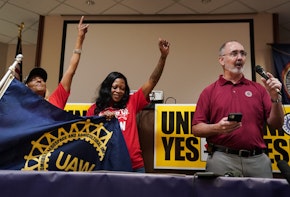
The last year was filled with political humiliation for unions:
Despite these snubs, unions continued to give heavily to Obama’s campaign, and they mobilized members and non-members alike, thanks in part to the new rules of Citizens United.
Now, their faithfulness in the face of these snubs has been rewarded with the nomination of the decidedly union-unfriendly Penny Pritzker for Secretary of Commerce. With this move, President Obama has once again shown unions that he takes their support for granted.
Blog Post by: Moshe Marvit, on May 2, 2013

Approximately 70 years ago, Republicans hit upon a winning formula: if the data disagree with your worldview, kill the data. Then, with no problematic data, claim that there is no definitive proof of reality and, in the words of Karl Rove, create your own reality.
Blog Post by: Michael Cohen, on May 2, 2013
The thriving metropolis of Boston was turned into a ghost town on an otherwise lovely Friday afternoon. Nearly a million Bostonians were asked to stay in their homes—and willingly complied. Schools were closed; business shuttered; trains, subways and roads were empty; usually busy streets eerily resembled a post-apocalyptic movie set; even baseball games and cultural events were canceled—all in response to a 19-year-old fugitive, who was on foot and clearly identified by the news media. While Boston officials appeared to be acting out of an abundance of caution—and it's appropriate for residents to be asked to take precautions or keep their eyes open—by letting one fugitive terrorist shut down a major American city, Boston not only bowed to outsize and irrational fears, but sent a dangerous message to every would-be terrorist. If you want to wreak havoc in the United States, intimidate its population and disrupt public order, here's your instruction booklet.
In April, I wrote a piece for the Guardian arguing that the reaction to the marathon bombing was dramatically at odds with American inertia over arms control. The infographic below illustrates some of my main points. (Click the image to see the full-sized version.)
Blog Post by: Andrew Fieldhouse, on May 1, 2013

Congressional Republicans have routinely obstructed attempts to ameliorate the ongoing jobs crisis and Lesser Depression, but some members are now demonstrating apathy toward the unemployed and impoverished so extreme they want to forgo data collection on unemployment and poverty.
Blog Post by: Harold Pollack, on May 1, 2013

It is difficult to imagine a more foolish proposed legislative measure than the ill-named Census Reform Act, which states that the Census Bureau “may only conduct the decennial census of population.”
Blog Post by: Joe Miller, on May 1, 2013

The very first post at FactCheck.org referenced that great line from the late Sen. Daniel Patrick Moynihan: “Everyone is entitled to their own opinion — but not their own facts.”
During the years I spent at FactCheck, I certainly wittnessed my share of politicians trying to make up their own facts. And while I wasn’t allowed to say this at the time, it was always pretty clear (to me, anyway), that one side was making up a lot more facts than the other. Conservatives have happily embraced half-truths and outright falsehoods. From “Death Panels” to climate change denialism to the austerity discussion to Paul Ryan’s budget math, the GOP appears to have embraced a policy of Making Stuff Up.
Blog Post by: Harold Pollack, on May 1, 2013

I’m more of a Tom Friedman fan than most of my progressive friends. But I believe he whiffed badly, and instructively, with today’s column: “It’s a 401(k) world.”
Friedman energetically presents his usual “world is flat” thesis that Americans must adjust to living in a rewired, more meritocratic, hyper-connected, and competitive world:
We now live in a 401(k) world—a world of defined contributions, not defined benefits—where everyone needs to pass the bar exam and no one can escape the most e-mailed list…
Blog Post by: Benjamin Landy, on May 1, 2013

Over at Quartz, Matt Phillips has a good post summarizing "everything you need to know" about the student loan story (in 17 charts, of course). All the usual data points are there—the massive upswing in total student debt as more students clamber for an ever-more expensive degree; the recent surge in delinquencies as millions of underemployed twenty-somethings fail to make their payments on time; the growth of the federal student lending market in response to the financial crisis.
But what is missing in Phillips' post, as in too many articles about student borrowing, is any acknowledgement of two critical facts. First, three out of four undergraduates in the United States attend a public college or university—only about 15 percent attend the costlier private schools that get so much attention in the press. And second, state funding for those public colleges and universities has collapsed over the last two decades, forcing students and their families to pay the difference.
Sign up for our mailing list and stay up to date on the latest happenings at The Century Foundation